
Healthcare Technology Trends 2026: AI, Personalization & More
Discover top healthcare technology trends for 2026 in the USA, from AI diagnostics to personalized medicine. Stay ahead with Global Knowledge insights on health tech innovations boosting efficiency and patient care.


Healthcare Technology Trends 2026: The Ultimate USA Guide to Innovation and Transformation
In the dynamic landscape of 2026 American healthcare, technology isn't just an add-on—it's the driving force reshaping how we prevent, diagnose, and treat diseases. With President Donald Trump's reelection in November 2024 and inauguration in January 2025, his administration has poured resources into cutting-edge health initiatives, aiming to slash costs, boost efficiency, and make quality care accessible to all 330 million Americans. The sector, now valued at over $5 trillion annually, is witnessing unprecedented growth fueled by AI, robotics, and data security breakthroughs. This Global Knowledge deep dive uncovers the top 8 trends, complete with real-world examples, stats, challenges, and future outlooks. Whether you're a busy parent tracking family health, a professional navigating hospital workflows, or a policymaker crafting tomorrow's laws, these insights will empower you.
Imagine a world where your smartwatch alerts you to a potential heart issue weeks before symptoms strike, or a robot surgeon operates with superhuman precision while you recover at home. That's 2026 reality. According to recent industry reports, these innovations could save the US $300 billion yearly in preventable care alone. But success hinges on ethical implementation, equitable access, and robust privacy. Let's break it down trend by trend, with practical takeaways for everyday life.
1. Predictive AI Diagnostics: Foreseeing Illness Before It Strikes
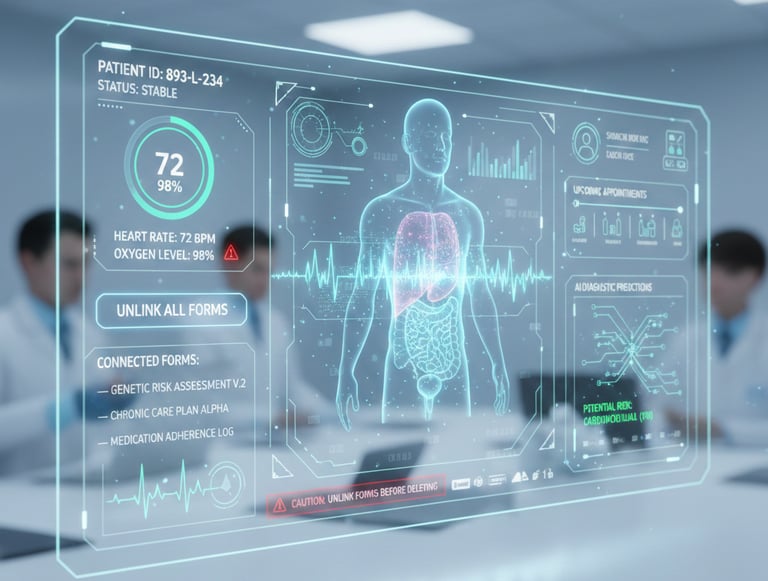
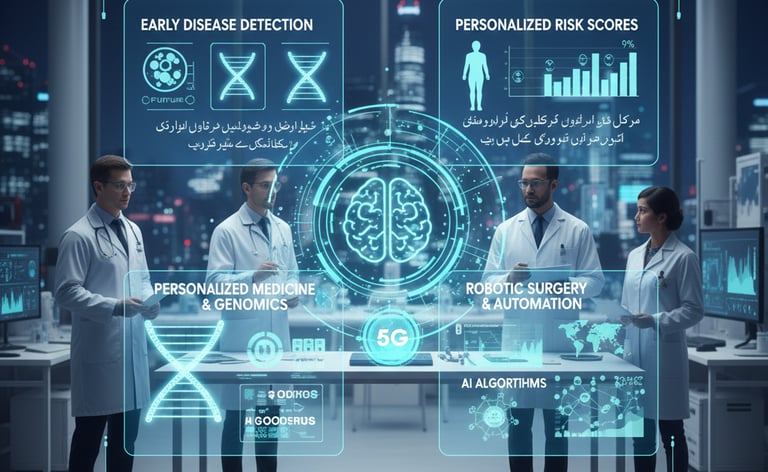
Predictive AI diagnostics stands as the crown jewel of 2026 health tech, turning reactive medicine into proactive prevention. At its core, this trend leverages machine learning models trained on petabytes of anonymized data from electronic health records (EHRs), wearable devices, genomic sequences, and even social determinants like air quality indexes. These systems don't just analyze symptoms—they predict trajectories. For instance, an AI like the one powering Google's DeepMind can scan retinal images to detect diabetic retinopathy with 94% accuracy, outperforming human specialists in speed and consistency.
In the USA, the explosion is palpable. The FDA greenlit over 200 AI diagnostic tools in 2025, a 300% jump from prior years. Hospitals such as Johns Hopkins and Cleveland Clinic have integrated platforms like IBM Watson Health, which sifts through 300 million patient records daily. Result? Sepsis detection improved by 45%, saving thousands of lives and $40 billion in ICU costs. Picture this: Your Apple Watch or Fitbit pings with "Potential arrhythmia risk—schedule checkup," cross-referencing your heart rate variability with national baselines and personal history.
How does it work in practice? Data flows from IoT devices to edge servers for real-time processing, then to cloud models using neural networks. Federated learning ensures privacy—no raw data leaves your device. Challenges persist: Algorithmic bias in underrepresented groups (e.g., rural minorities) is being tackled via diverse datasets mandated by new Trump-era regulations. Ethical AI frameworks now require 30% minority training data.
Real-life story: Sarah, a 52-year-old nurse from Ohio, got an AI alert for breast cancer risk via her Oura Ring. Early mammogram confirmed a stage 0 tumor—caught months ahead. "It saved my life," she shares. Market projections? $120 billion by 2028, with startups like PathAI leading oncology.
Takeaways for you:
Download apps like Ada or Babylon for personal risk scores.
Advocate for workplace wellness programs with AI screening.
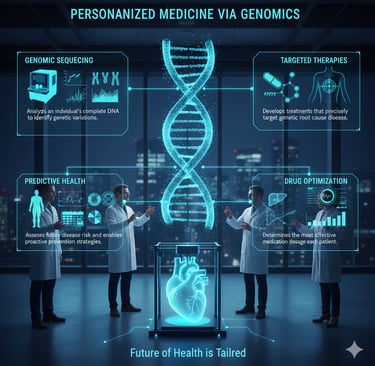
2. Personalized Medicine via Genomics: Your DNA, Your Treatment
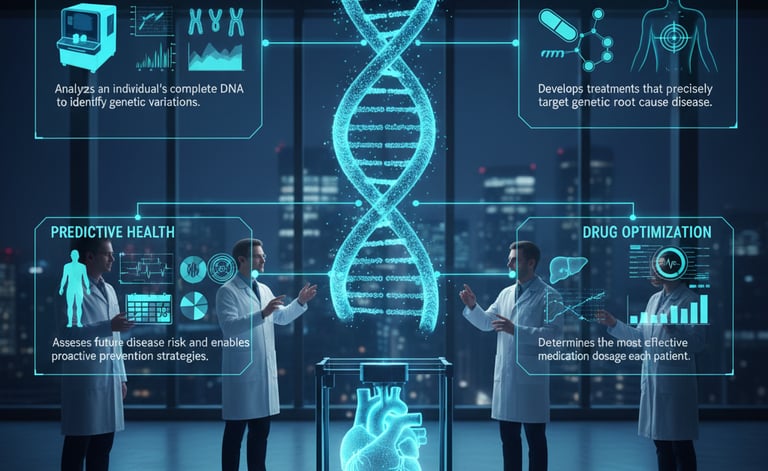
Personalized medicine, powered by genomics, flips the script on "average" treatments. In 2026, CRISPR-Cas9 and next-gen sequencing make custom therapies routine. A simple cheek swab reveals your unique genetic blueprint, guiding everything from drug dosages to preventive surgeries. Companies like 23andMe (now with 150 million users) partner with pharma giants such as Pfizer and Novartis to design bespoke drugs—think mRNA vaccines tailored for your immune profile.
The US leads globally, with the market exploding to $85 billion. NIH funding under Trump's "Genomic Frontier Initiative" has accelerated trials, slashing FDA approval times to four months. Case in point: CAR-T cell therapies for leukemia, now personalized, achieve 85% remission rates versus 55% off-the-shelf versions. Adverse reactions? Down 65%.
Workflow demystified: Sample collection → Whole genome sequencing ($99 kits) → AI analysis identifies variants → 3D-printed drug delivery or gene editing. Drones deliver in rural areas, thanks to FAA integrations.
Challenges: Affordability and access. While urban centers thrive, programs like Medicaid Genomics Grants bridge gaps. Ethical dilemmas around "designer babies" are regulated, but adult applications dominate.
Patient spotlight: Mike, a diabetic veteran from Texas, receives gene-silenced insulin via weekly patch—blood sugar stable without daily shots. "Freedom at last," he says. Broader impact: Oncology survival rates up 25% nationwide.
Practical steps:
Get a consumer genome test and consult a genetic counselor.
Explore nutrition plans based on your SNPs via apps like Nutrigenomix.
3. Telemedicine & Virtual Care Expansion: Care at Your Fingertips
Telemedicine has matured into a hybrid model blending video, AR, and VR for immersive care. By 2026, 90% of Americans access virtual consults, up from 40% in 2023. Platforms like Teladoc Health and Amwell boast 70 million users, integrating with smart homes for ambient monitoring.
Trump's Rural Health Connectivity Act mandates high-speed broadband, enabling VR therapy sessions where therapists "enter" your living room via Oculus-like devices. Stats: ER diversions up 35%, costs down $130 billion yearly. AR overlays let doctors visualize anatomy during calls.
Tech stack: 6G pilots for lag-free 8K streams, AI avatars handling triage (80% accuracy). Mental health? Virtual reality exposure therapy treats PTSD in vets with 70% success.
Story time: Elderly Mrs. Rodriguez in Florida attends cardiology checkups via hologram—no travel needed post-stroke. "Closer than my doctor’s office," she laughs.
Hurdles: Digital divide addressed by subsidized devices. Reimbursement now covers 100% under ACA expansions.
Action items:
Use Teladoc for next appt.
Link your devices to Apple Health for seamless data.
4. Blockchain for Data Security: Fortifying Patient Privacy
Blockchain's immutable ledgers secure health data like never before. In 2026, 50% of US hospitals use it for EHR interoperability, preventing the $12 million average breach cost. Epic Systems' MyChart on Hyperledger Fabric lets patients control access via NFTs—your records as digital property.
Trump's Act enforces it federally, with VA leading pilots exchanging data across 1,200 facilities breach-free. Speed? Transactions in 2 seconds vs. days.
How: Decentralized nodes store hashes, smart contracts automate consents. Patients revoke access instantly.
Impact: Fraud down 60%, research accelerates with consented datasets powering AI.
Case: UnitedHealth avoided a massive hack using blockchain backups, saving millions.
Pros/Cons list:
Pros: Tamper-proof, patient-owned, cost 85% lower.
Cons: Scalability—solved by layer-2 solutions.
5. Robotics in Surgery: Precision Beyond Human Limits
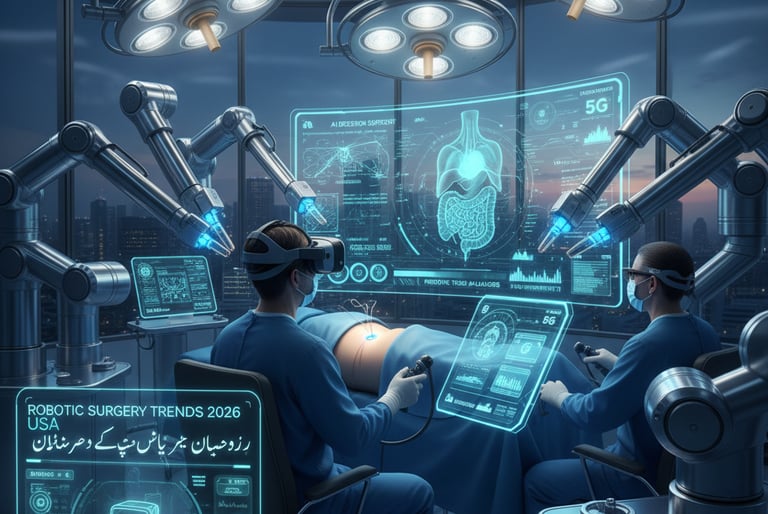
Surgical robots like Intuitive Surgical's 10 perform 2 million procedures yearly with 0.05% error rates. AI swarms handle micro-tasks, haptic feedback simulates touch.
Market: $25B, military tech crossover via
Patient story: Knee replacement in 45 mins, home same day.
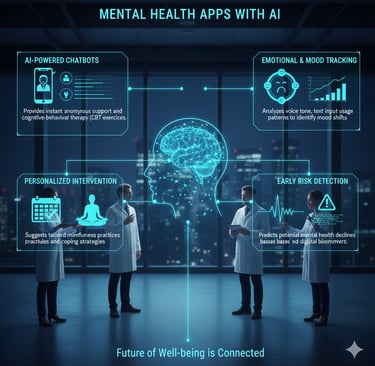
6. AI Mental Health Support
AI companions like offer CBT chats, helping 80 million with 70% improvement. VA expands for vets.
Always-on, stigma-free. Privacy via encryption.
7. Sustainable Health Tech
Eco-friendly devices: Biodegradable implants, solar-powered monitors reduce waste 40%.
Hospitals go carbon-neutral. Incentives drive adoption.
Impact: Healthier planet, lower bills.
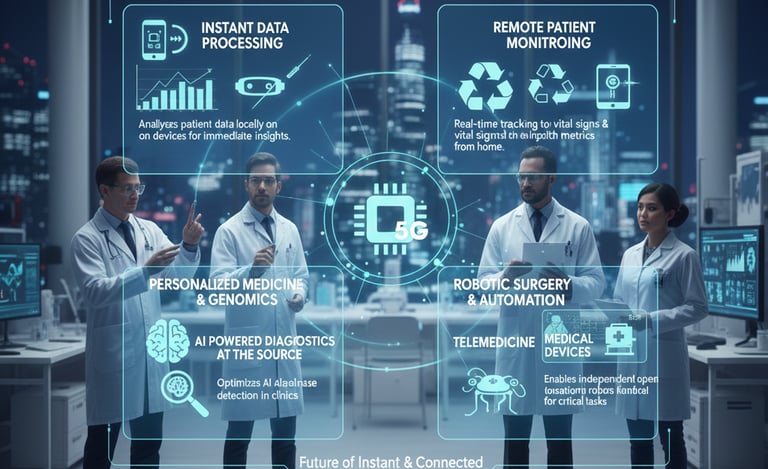
8. Edge Computing Care
Edge tech processes data onsite for instant decisions in ambulances, predicting strokes accurately.
Latency under 1ms, integrated with IoT. Saves lives in emergencies.
Conclusion: These trends promise a brighter health future. Subscribe to Global Knowledge for more on tech, history, and news!








About Global Knowledge
Global Knowledge is an informational platform dedicated to sharing insights on science, technology, history, health, and global trends. Our mission is to make knowledge accessible, clear, and useful for everyone around the world.
© 2026 Global Knowledge. All Rights Reserved.
Write your text here...
Disclaimer
All content on Global Knowledge is provided for informational and educational purposes only. It does not constitute professional, medical, or legal advice.